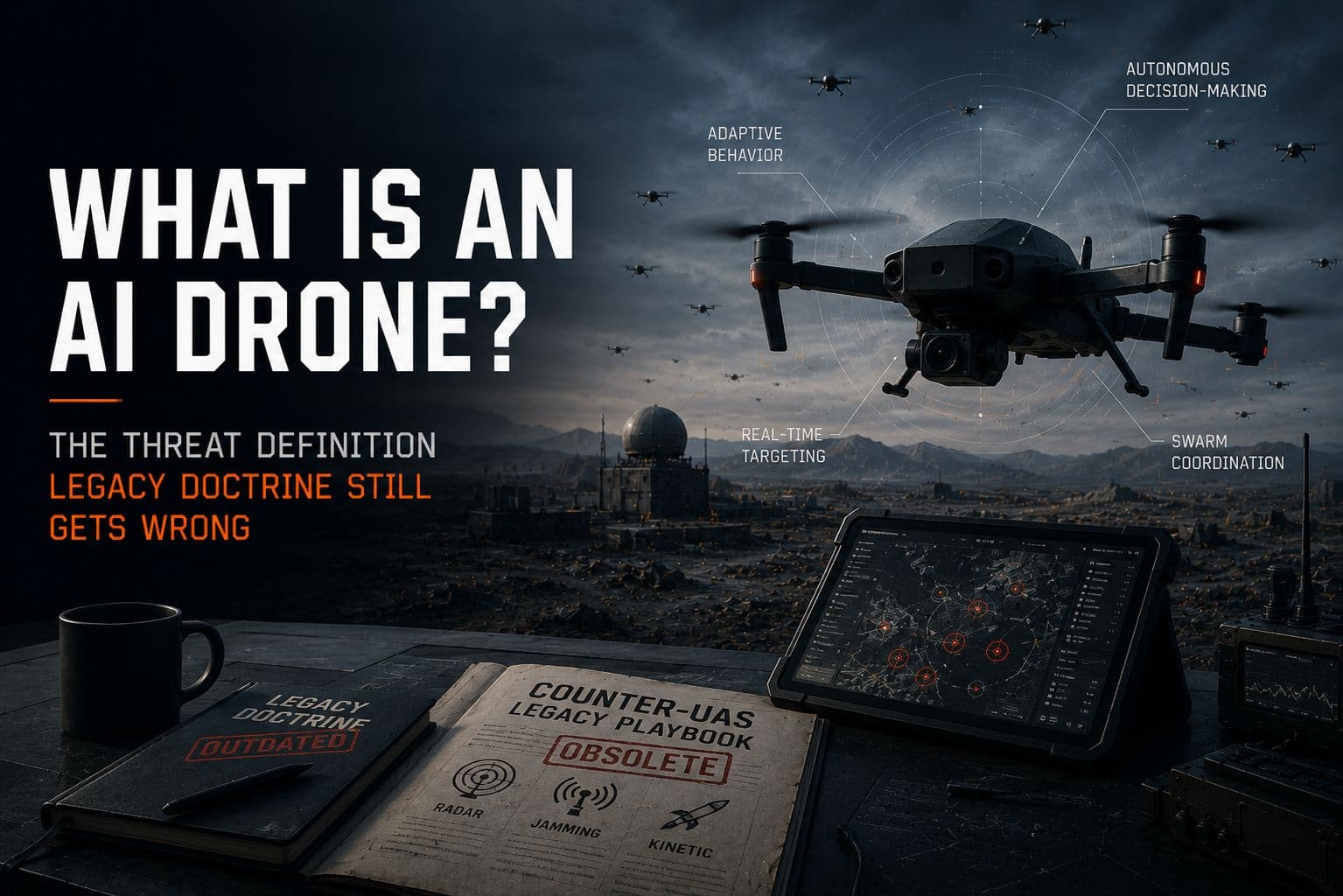
Most procurement language still defines an AI drone as a piloted aircraft with smarter avionics. That definition was already outdated before the war in Ukraine made it obsolete entirely. An AI drone is not a better-flown drone; it is a drone that no longer needs a pilot's decision loop at all.
Executive Summary
- An AI drone replaces the human decision loop with onboard, goal-directed logic. It does not simply automate piloting; it removes the pilot from the threat model.
- Legacy counter-UAS doctrine assumes a signal to detect and a human to disrupt. Neither assumption holds against autonomous, AI-coordinated platforms.
- The decisive question for any defense command is not how many AI drones an adversary can field, but whether the command can disrupt the coordination logic behind them.
- HokuQ is built to answer that question at the logic layer, not the airframe layer.
Why 'AI Drone' Is Not a Marketing Term
The phrase AI drone is frequently used loosely, applied to anything from a consumer quadcopter with obstacle-avoidance software to a fully autonomous, swarm-coordinated military platform. For a defense procurement officer, that looseness is dangerous. The capability gap between an automated drone and an autonomous one is the entire gap between yesterday's threat model and today's.
An automated drone still depends on a remote operator for tactical decisions and a communications link to receive them. An autonomous AI drone makes those decisions onboard, in real time, using agentic AI that adapts to the environment without waiting on a human or a signal.
The Doctrine Gap This Creates
Every generation of counter-UAS investment, detection radars, RF jamming, kinetic intercept, was engineered against the automated model: find the signal, sever the signal, or destroy the airframe. An AI drone with no required signal and no single point of human failure simply does not present the target those systems were built to find.
This is why detection-only platforms increasingly report a drone's presence without offering any way to stop what it is coordinated to do next. Identification is not defense.
Where the Real Attack Surface Lives
If an AI drone's defining feature is autonomous, AI-driven decision-making, then the actual attack surface is the coordination logic running that decision-making, not the airframe carrying it. HokuQ's distributed sensor fusion and quantum-secure signal disruption are engineered to operate at that logic layer, designed to disrupt the AI coordination stack regardless of drone type, size, or origin.
This is also why the threat scales differently than legacy doctrine assumes. A single AI drone and a hundred-unit AI-coordinated swarm are not different in kind; they run on the same coordination logic, just distributed across more airframes. Defending the logic layer is what makes a counter-AI-drone capability swarm-agnostic by design.
What This Means for Procurement
Any capability evaluation should now ask a direct question: does this system defeat the airframe, or does it defeat the decision-making that controls the airframe? Systems that only answer the first question will report accurate detections of a threat they cannot neutralize.
Understand where your current capability stops detecting and starts defending. Request a briefing from HokuQ's doctrine team.