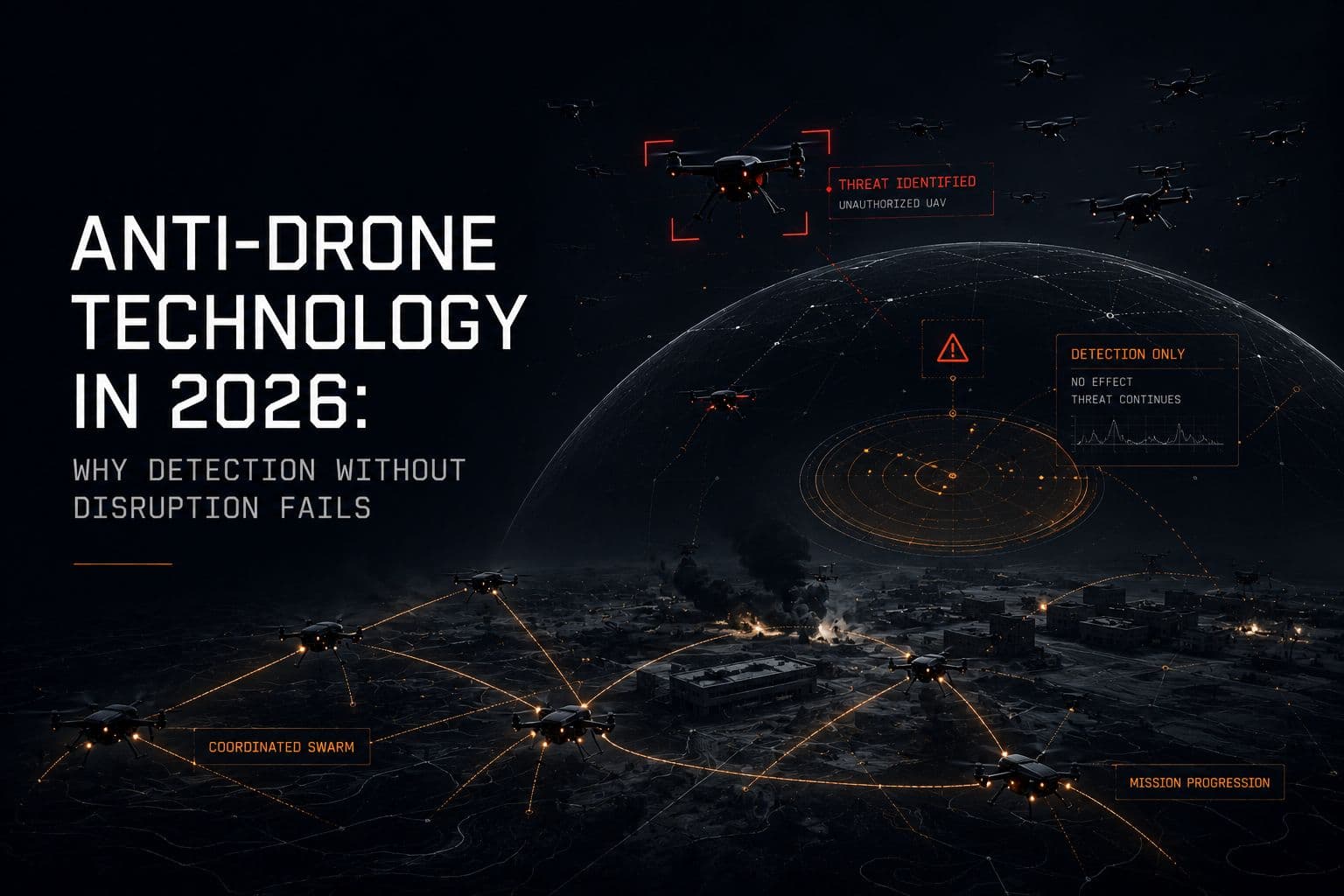
The anti-drone market is crowded with sensors that tell you a swarm is coming. Knowing it is coming is not the same as being able to stop it.
Executive Summary
- Most anti-drone technology on the market detects and identifies drones. Far less of it can actually defeat an autonomous swarm.
- Detection is necessary but not sufficient: knowing a swarm is inbound does not stop it if you cannot engage what coordinates it.
- The decisive capability is disruption at the coordination layer, neutralising the intelligence that drives the swarm.
Anti-drone technology spans a wide range of systems, but most of it concentrates on one half of the problem: detection. Sensors that spot, classify, and track incoming drones have become sophisticated and widely available. They answer the question "is a drone there?" with increasing precision.
The harder half, actually defeating an autonomous swarm, is where the market thins out and where the real challenge lies. In 2026, the gap between detection and disruption is the defining weakness of conventional anti-drone technology, and closing it requires engaging a layer most systems never touch.
What Today's Anti-Drone Technology Does Well
The anti-drone market has largely solved detection: modern sensors can find, classify, and track incoming drones with real precision.
Radar, electro-optical, acoustic, and signal-based sensors have matured into capable detection systems. They can identify that drones are present, often classify the type, and track their movement. This is genuine progress and a necessary foundation.
But detection is the beginning of the problem, not the end. A sensor that perfectly identifies an inbound swarm has not stopped a single drone. The value of detection is realised only when it enables disruption.
Where Detection Stops Being Enough
Against an autonomous swarm, knowing it is inbound changes nothing if you cannot engage the intelligence coordinating it.
A human-operated drone could be defeated once detected by targeting its operator or link. An autonomous swarm offers neither. Detection tells you the swarm is there; it does not give you a way to defeat a threat that has no pilot and no single signal.
This is the trap of detection-centric anti-drone technology: it provides excellent awareness of a threat it cannot actually stop. Awareness without an effective response is, at best, a more precise way to watch an attack arrive.
The Disruption Layer That Matters
Defeating an autonomous swarm means disrupting its coordination layer, the intelligence that makes it act as one.
The effective point of disruption is not the individual airframe but the AI coordination stack that drives the swarm. Neutralise that, and the swarm loses the coordination and adaptability that make it dangerous. This is disruption aimed at the cause rather than the symptom.
Conventional effectors do not operate at this layer. They engage individual drones, which against a numerous, autonomous, self-correcting swarm is an arithmetic an attacker is happy to accept: they have more cheap drones than you have expensive responses.
What Procurement Should Demand
The right question for any anti-drone system is not how well it detects, but whether it can disrupt what coordinates an autonomous swarm.
Decision-makers should treat detection as table stakes and focus evaluation on disruption: against a swarm with no pilot and no single signal, what does the system actually defeat? A capability strong on detection and silent on coordination-layer disruption answers only half the problem.
HokuQ is built around the half the market underserves, disruption at the quantum-secure AI coordination layer that drives the swarm. Detection tells you the threat is real; disruption is what ends it.
Detection is table stakes. Disruption ends the threat. Request a HokuQ capability briefing.