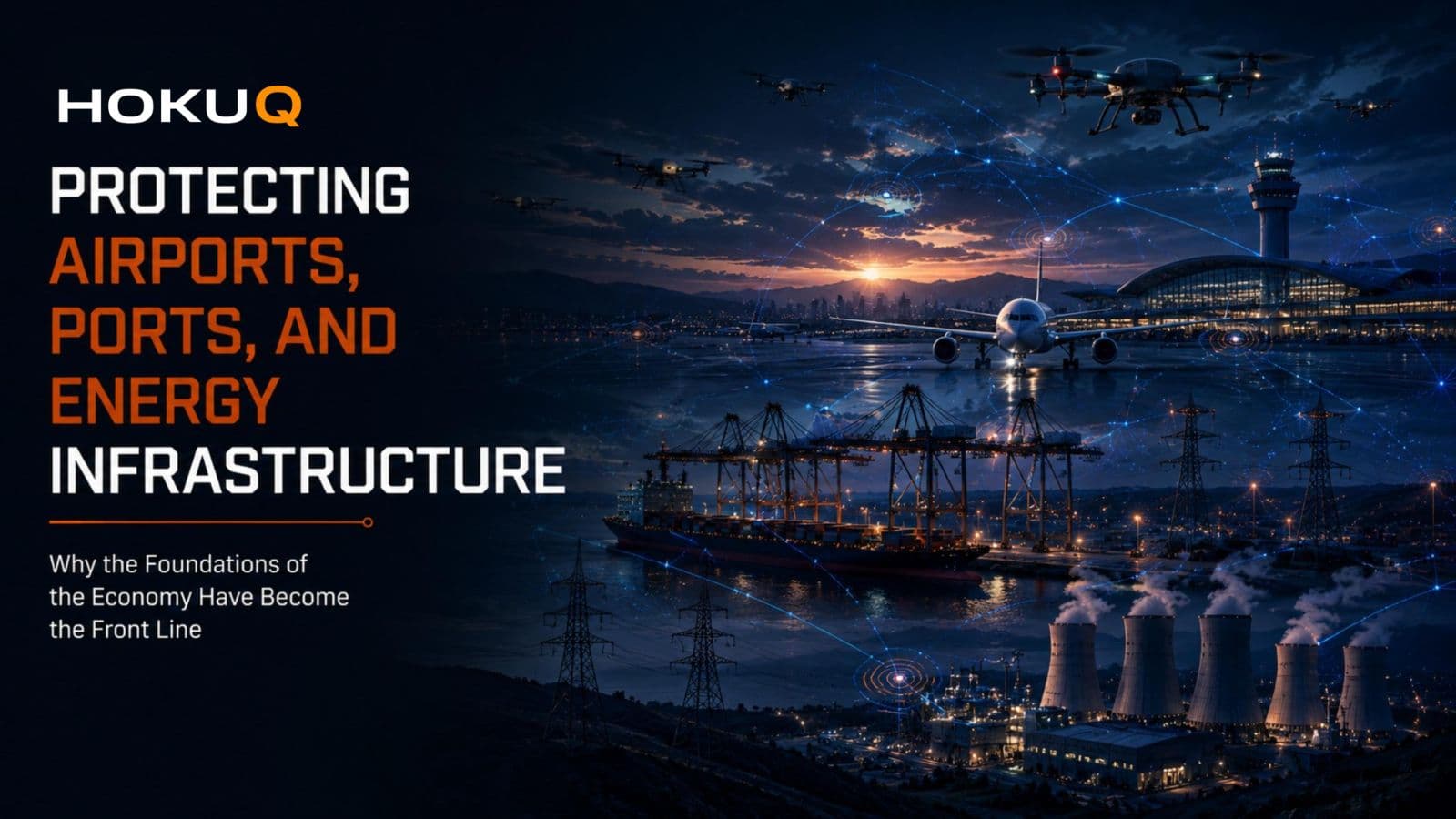
Why the Foundations of the Economy Have Become the Front Line
Every economy rests on a handful of places.
The airports that connect it. The ports that feed it. The power plants and grids that keep everything else alive.
For decades, these were engineering assets: managed for uptime, budgeted for maintenance. They are now something else entirely. They are the front line.
Small Threats, Outsized Consequences
At an airport, a single unidentified drone can ground hundreds of flights.
At a port, a brief intrusion can idle cranes that move a nation's imports. At a substation or refinery, minutes of interference can cascade into hours of darkness.
The defining feature of these environments is asymmetry of consequence: the cost of the disruption bears no relationship to the cost of the object that caused it.
The Hardest Places to Defend
These are also the most constrained environments in all of security.
They are surrounded by civilians. Their airspace overlaps flight paths, cities, and shipping lanes. The response options available on a battlefield, jamming broadly or firing freely, are unavailable above a passenger terminal.
Defense here cannot simply be powerful. It must be precise, lawful, and safe for everyone standing under it.
False Alarms Are Their Own Attack
In an environment where a sighting alone can force a shutdown, every false alarm carries a real price.
A defense that cannot distinguish a hobbyist from a hostile actor does not protect the infrastructure. It hands the attacker a cheaper weapon: the shutdown itself, triggered on demand.
The decisive capability is not detection. It is judgment, the ability to understand intent quickly enough to act on genuine threats and stand down for everything else.
One Picture, Many Guardians
No single organization owns the defense of an airport, a port, or a grid.
Operators, police, aviation authorities, coast guards, and militaries all hold a piece of the response. In the decisive minutes, they need what they rarely have: the same picture, at the same moment, with the same understanding of what is happening.
Shared awareness is not a convenience in these environments. It is the difference between coordination and chaos.
The HokuQ Perspective
At HokuQ, we believe protecting critical infrastructure is where intelligent defense proves its worth, because these environments punish everything except precision.
An economy is rarely brought down by what destroys its infrastructure. It is brought down by whatever convinces its infrastructure to stop.