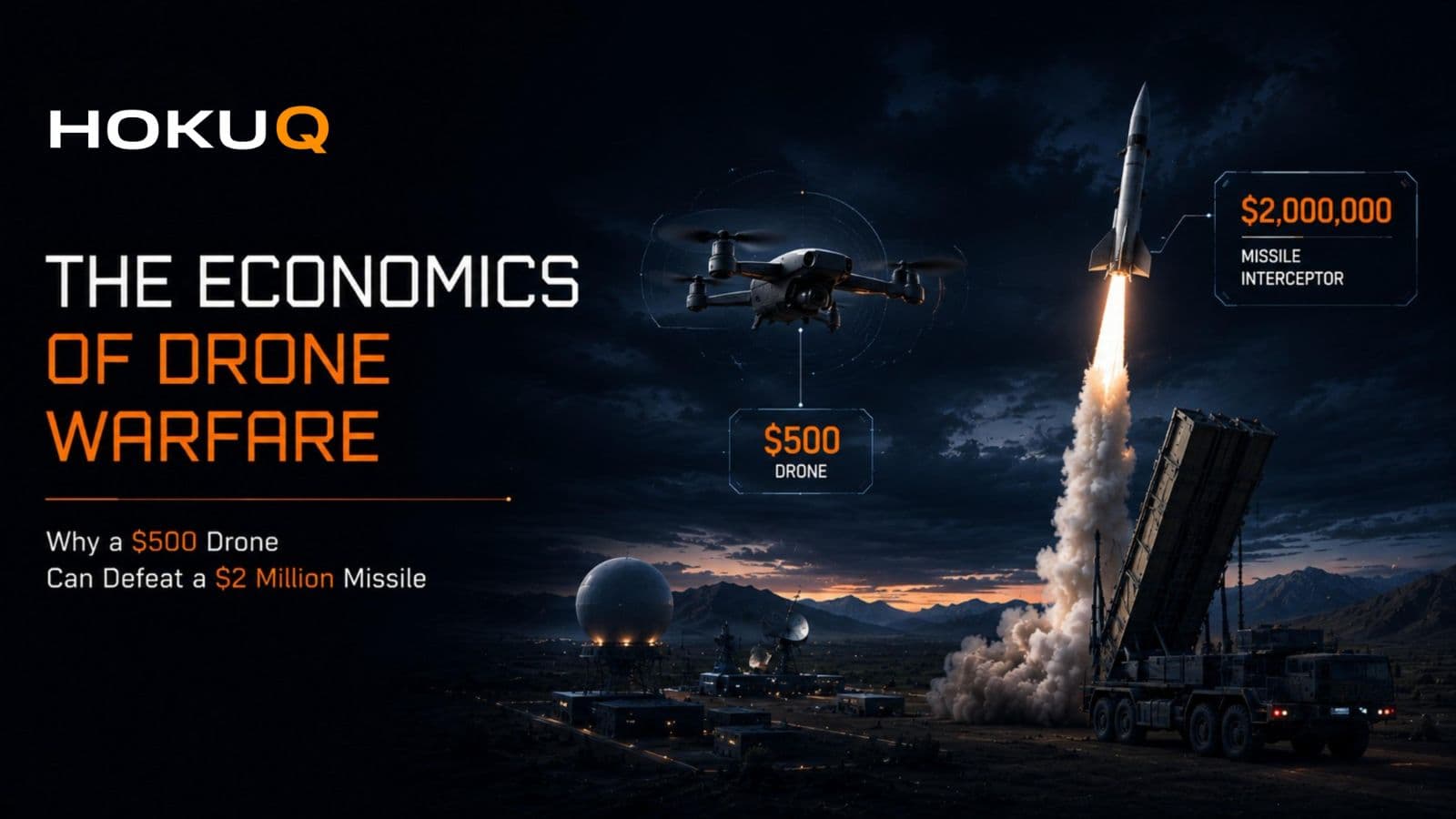
Why a $500 Drone Can Defeat a $2 Million Missile
Every era of warfare has carried its own arithmetic.
For most of modern history, that arithmetic favored the defender. Attacking a protected target required resources only a state could assemble: aircraft, missiles, trained crews, and the industrial base behind them.
That arithmetic has now inverted.
A commodity drone built from off-the-shelf components can force a defender to fire an interceptor worth thousands of times its cost. The attacker spends hundreds of dollars. The defender spends millions. Only one of them can afford to keep going.
The New Arithmetic
The most important question in modern defense is no longer whether a threat can be stopped. It is what stopping it costs.
When every engagement drains the defender faster than the attacker, victory in the engagement becomes defeat in the campaign. The attacker does not need to penetrate defenses. The attacker only needs to make defense unaffordable.
This is attrition by economics, and it is already reshaping how conflicts are fought.
Why More Interceptors Are Not the Answer
The instinctive response is to buy more interceptors, build deeper magazines, and field additional batteries.
But scaling an expensive response to a cheap threat does not correct the imbalance. It institutionalizes it. Every additional interceptor purchased at a losing exchange rate commits the defender more deeply to an unsustainable model.
The problem is not the quality of the interceptor. It is the structure of the exchange.
Changing What Defense Costs
The way out of a broken exchange rate is not a cheaper missile. It is a different target.
An autonomous threat is more than an airframe. It is navigation, coordination, and decision-making: an intelligence that tells it where to go and what to do. Disrupting that intelligence does not consume a missile. It consumes information, and information scales at a fraction of the cost.
When defense shifts from destroying every unit to defeating the system that directs them, the economics begin to favor the defender again.
The HokuQ Perspective
At HokuQ, we believe the defender's advantage will be restored through intelligence, not through deeper magazines.
The nations that master this new arithmetic will protect more with less. Those that do not will win engagements and lose budgets.
The $500 drone does not defeat the $2 million missile because it is better. It wins because of what it costs. And the question that should occupy every defense leader is a simple one: what happens when there are ten thousand of them?