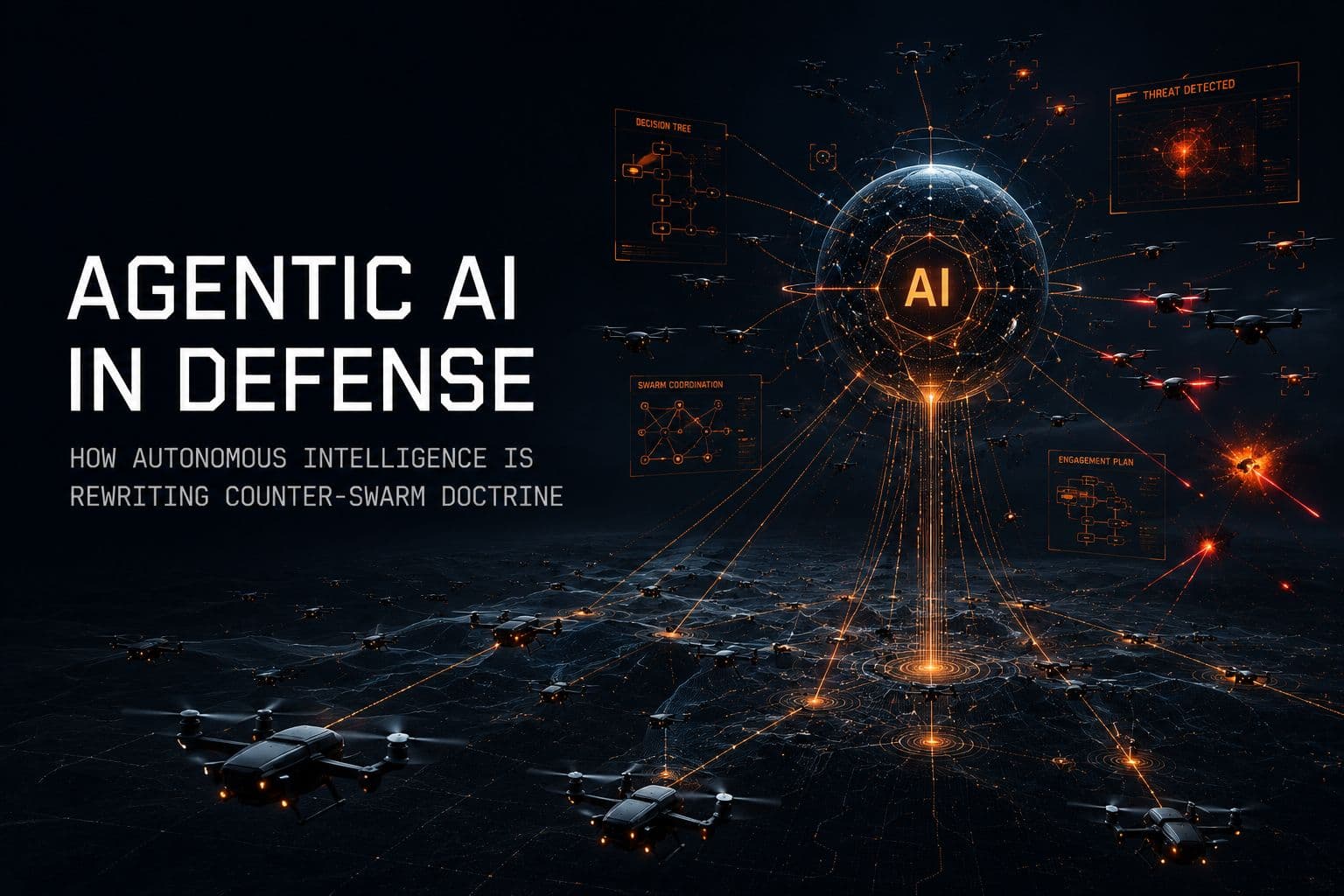
The most consequential development in autonomous warfare is not a new weapon. It is a new kind of intelligence, and most defense planning has not caught up to what it changes.
Executive Summary
- Agentic AI is software that pursues goals autonomously: deciding and acting without step-by-step human direction.
- In defense, agentic AI is what makes a drone swarm a coordinated, adaptive threat rather than a flock of individual aircraft.
- The same class of intelligence that drives the swarm is the layer at which the swarm can be defeated. The war is moving from the airframe to the algorithm.
Agentic AI describes systems that act autonomously toward a goal: they perceive, decide, and execute without a human directing each step. In the commercial world the term is associated with software agents that complete tasks on their own. In defense, agentic AI is the intelligence that lets autonomous drones coordinate, adapt, and pursue an objective as a group.
This is the development that has rewritten the counter-swarm problem. When the intelligence driving an attack is itself autonomous and adaptive, the threat is no longer a collection of airframes; it is a distributed decision-making system. Understanding agentic AI is the prerequisite to understanding why the next era of defense is fought at the layer of logic, not the layer of hardware.
What Agentic AI Actually Is
Agentic AI is software that pursues goals on its own, perceiving its environment, making decisions, and acting without a human directing each step.
Unlike a tool that waits for instructions, an agentic system is given an objective and works toward it autonomously, adjusting to conditions as it goes. It is the difference between a remote-controlled device and one that decides for itself how to reach its goal.
This autonomy is what makes the technology so powerful, and in adversarial hands, so dangerous. An agentic system does not need a continuous human link, which removes the dependency every legacy countermeasure was built to exploit.
Why Agentic AI Changes Warfare
Agentic AI decouples lethality from human command. A swarm driven by autonomous intelligence keeps fighting even when every link to a human operator is gone.
For the entire history of warfare, force required a human in the loop: someone aiming, flying, or directing. Agentic AI breaks that requirement. The intelligence that coordinates a swarm is onboard and autonomous, so the swarm pursues its objective without anyone steering it.
This is why the drone swarm is such a difficult threat. There is no operator to capture, no link to sever, no single point whose removal collapses the attack. The capability lives in distributed, autonomous logic.
The Coordination Stack Is the Center of Gravity
In an agentic swarm, the coordination layer is the center of gravity: the element whose disruption defeats the whole, not just a part.
Military doctrine has always sought the center of gravity: the source of an adversary's strength. For an autonomous swarm, that center is not any drone. It is the AI coordination stack that turns individual aircraft into a single adaptive system.
Engage that layer and the swarm loses what makes it dangerous: its coordination, its adaptability, its ability to act as one. This is the strategic insight on which modern counter-swarm doctrine should be built.
What This Means for Defense Planners
Defense built around defeating airframes is fighting the symptom. Defense built around the agentic coordination layer fights the cause.
Planners who frame the drone threat as a problem of shooting down or jamming individual aircraft are addressing the symptom. The cause is the autonomous intelligence coordinating the attack. A capability that does not engage that intelligence will always be one step behind an adaptive swarm.
HokuQ is built on the opposite premise: that the agentic coordination layer is both the source of the threat and the place to defeat it. The future of defense is fought at the algorithm, and the doctrine that recognises this first will hold the advantage.
The next war is fought at the algorithm. Request a briefing on HokuQ's agentic counter-swarm approach.