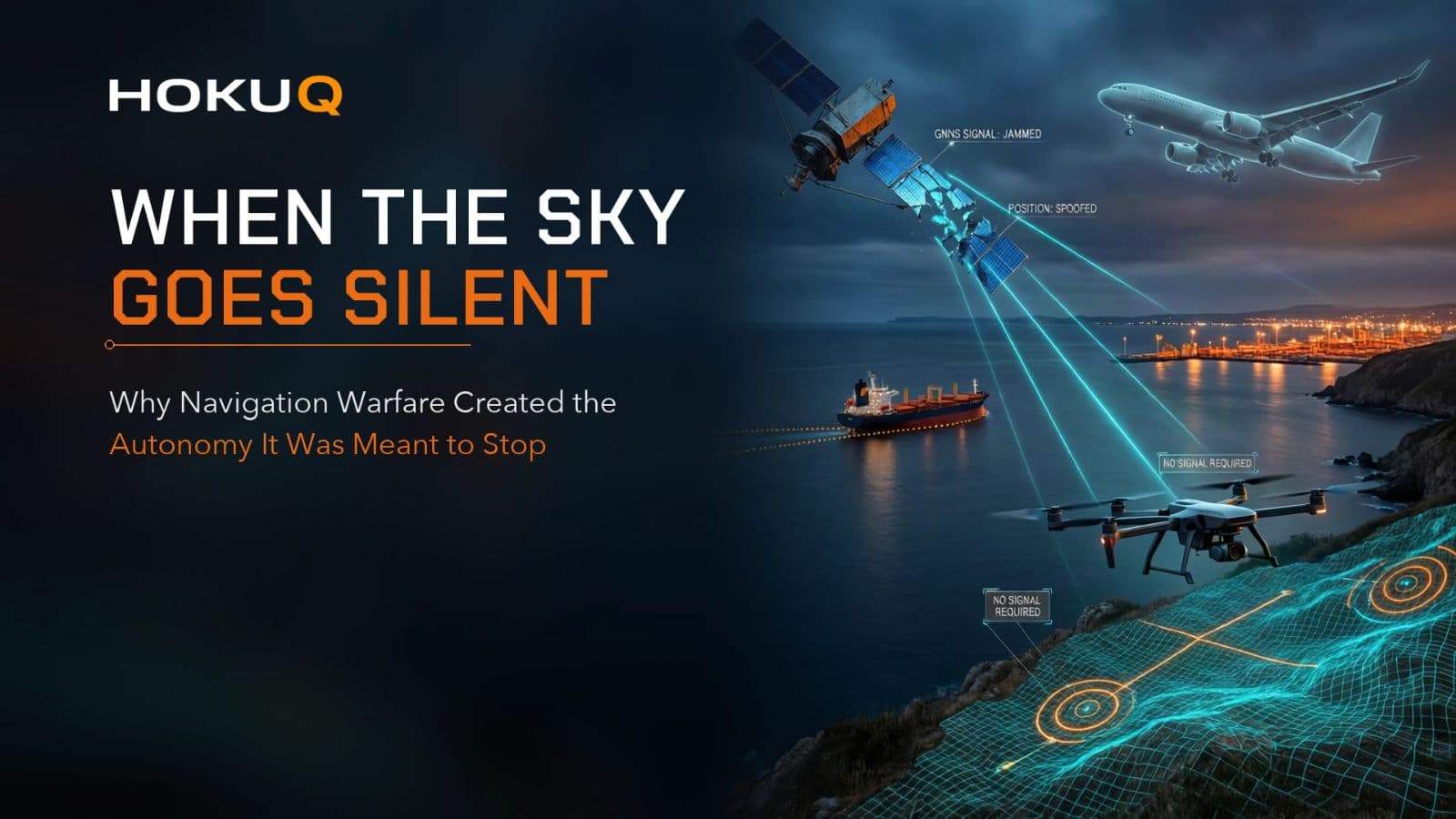
Why Navigation Warfare Created the Autonomy It Was Meant to Stop
Modern life runs on a signal almost no one thinks about.
Satellite navigation times financial transactions, routes shipping, synchronizes power grids, and guides nearly everything that moves with precision. It is faint, freely available, and remarkably fragile.
It is also, increasingly, the first thing to disappear.
The Contested Signal
Jamming and spoofing have moved from exotic capability to routine condition.
There are now regions where navigation is unreliable for everyone inside them. Aircraft report false positions. Ships drift from their charts. Civilian systems fail alongside military ones.
The signal was never designed to survive an adversary. It was designed to be useful.
Denial Produced the Thing It Was Meant to Prevent
Denying navigation was supposed to disable the weapon. Instead it changed the weapon.
A system that cannot depend on satellites must navigate by what it can see, sense, and remember. That requirement did not slow autonomous development. It defined it.
This is the uncomfortable irony of navigation warfare: the pressure to remove the signal accelerated the arrival of machines that no longer need one.
The Defender Depends on It Too
Denial is never one-sided.
The same signal that guides an intruder synchronizes the defender's sensors, coordinates the defender's response, and timestamps the defender's picture. A contested environment degrades both.
The side that planned for silence keeps operating. The other spends the critical minutes trying to reconnect.
Designing for Absence
Resilience means never depending on a single source of truth.
Multiple independent sensors, redundant timing, and systems that continue to function when a familiar input disappears without waiting to be told what to do.
The measure of a modern defense is what remains when its most convenient input is taken away.
The HokuQ Perspective
At HokuQ, we believe resilience in the autonomous era begins with an assumption rather than a hope: the signal will not be there.
Systems designed for perfect conditions will perform beautifully until the moment they matter. Systems designed for silence will still be working when the sky goes quiet.