The Economics of Autonomous Defence Are Changing
For decades, defence superiority has often been measured by capability.
Range.
Speed.
Precision.
Firepower.
Survivability.
But autonomous systems are introducing another variable that may prove just as important:
Economics.
What happens when a relatively inexpensive autonomous threat requires a vastly more expensive defensive response?
What happens when that occurs not once, but hundreds or thousands of times?
At some point, the question is no longer simply whether a threat can be defeated.
The question becomes:
At what cost?
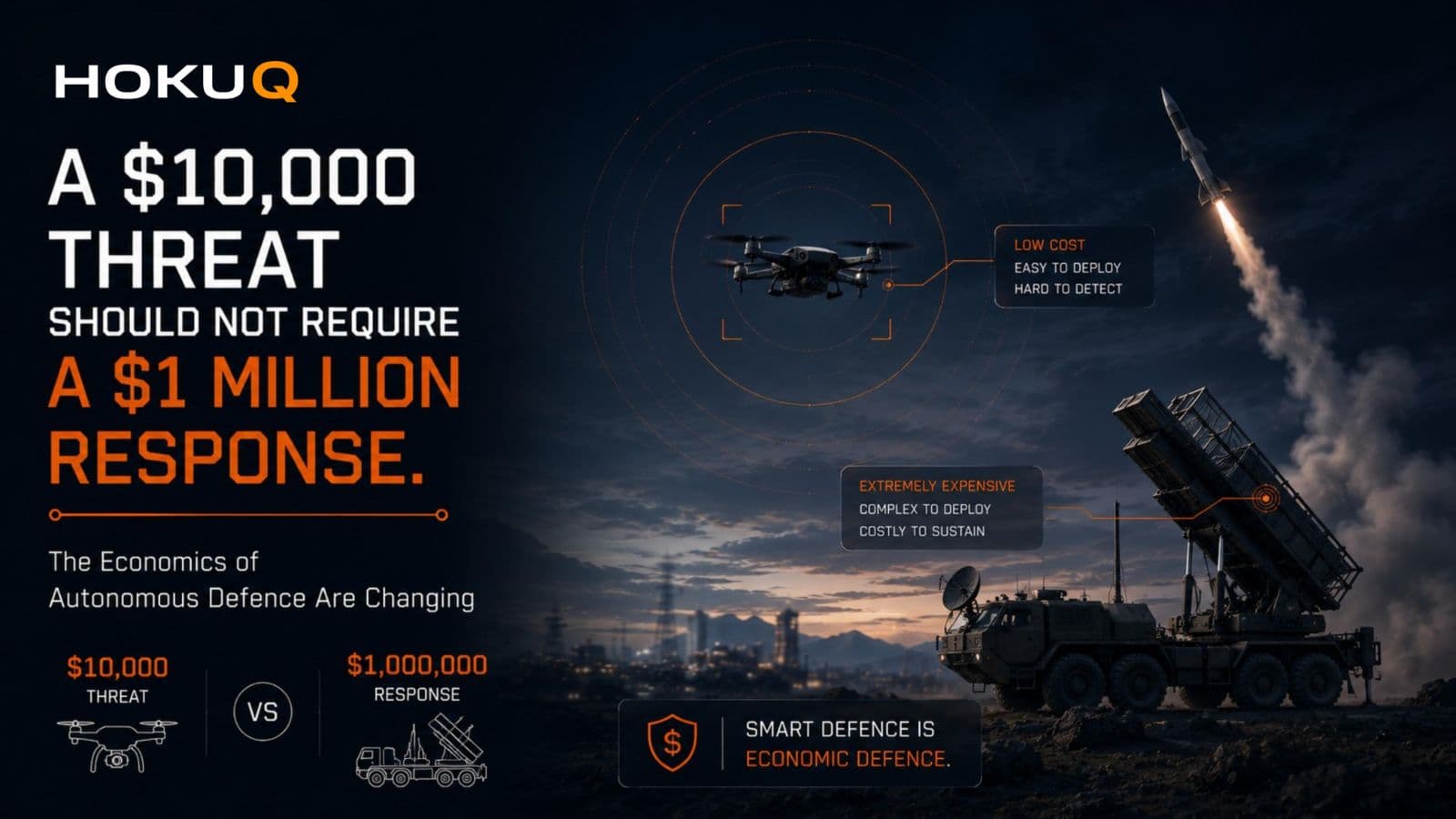
A $10,000 threat should not routinely require a $1 million response.
Because even if the defender successfully intercepts every threat, the economics can still favour the attacker.
Winning the Engagement. Losing the Equation.
Traditional defence systems were built for a world where many threats were themselves sophisticated and expensive.
That economic balance is changing.
Commercial technologies, inexpensive components, increasingly capable sensors and rapidly advancing artificial intelligence are lowering the barriers to building autonomous systems.
The result is an emerging class of threats that can potentially be produced and deployed at dramatically different economics than the systems traditionally used to defend against them.
This creates an uncomfortable reality.
A defender can successfully neutralize every incoming threat and still face an unsustainable outcome.
If an attacker can repeatedly deploy inexpensive systems while forcing the defender to consume significantly more expensive resources, the attacker does not necessarily need technological superiority.
They may simply need better economics.
The Cost Exchange Ratio
This creates what is increasingly becoming one of the most important equations in modern defence:
The cost exchange ratio.
Imagine an inexpensive autonomous system approaching critical infrastructure.
The defender successfully detects it.
Tracks it.
Engages it.
And destroys it.
Operationally, the engagement was successful.
Economically, however, the outcome may look very different if the defensive response costs many times more than the threat itself.
Now multiply that equation.
Ten threats.
One hundred.
One thousand.
The economics change rapidly.
This is why the future of autonomous defence cannot simply be about creating increasingly sophisticated ways to destroy individual threats.
It must also be about creating scalable ways to defeat them.
Scale Changes Everything
One inexpensive autonomous system can be a problem.
A coordinated group can become an entirely different challenge.
As autonomous systems become more capable of communicating, coordinating and adapting collectively, defence architectures designed primarily around individual target engagement may face increasing pressure.
The problem is not simply volume.
It is simultaneous complexity.
Multiple systems can potentially approach from different directions.
Threats can appear at different speeds and altitudes.
Some systems may be designed to distract.
Others may collect information.
Others may carry out the primary objective.
The defender must determine what is happening, identify the greatest threats and allocate resources appropriately.
Doing that manually becomes increasingly difficult as the number of systems grows.
This is where intelligence becomes critical.
Intelligence Before Interception
The most effective response does not necessarily begin with an interceptor.
It begins with understanding.
What is the object?
Where is it going?
Is it actually a threat?
Is it operating independently?
Is it part of a coordinated network?
What assets are potentially at risk?
What response is appropriate?
And what is the most efficient way to neutralize the threat?
Artificial intelligence and autonomous coordination have the potential to dramatically improve how these decisions are made.
Instead of treating every detected object equally, intelligent defence architectures can help create a more dynamic response.
Detect. Understand. Prioritize. Coordinate. Respond.
The objective is not simply faster interception.
It is smarter resource allocation.
Fighting Autonomy With Autonomy
There is another fundamental shift underway.
As threats become increasingly autonomous, defensive systems may also need greater autonomy.
Human operators remain essential to command, authorization and mission objectives.
But humans cannot manually coordinate every sensor, every platform and every response when threats begin operating at machine speed and at significant scale.
Autonomous defensive systems can potentially help process information across distributed sensors, coordinate multiple assets and execute authorized responses within established operational boundaries.
This creates a different model for defence.
Instead of one expensive system responding to one inexpensive threat, networks of intelligent systems can work together to determine the most appropriate response.
The advantage moves from the individual platform to the intelligence connecting the network.
The Swarm Changes the Economics
Swarm intelligence could further change the equation.
A distributed autonomous network does not necessarily depend on one platform to provide every capability.
Different systems can contribute different information and capabilities.
One detects.
Another observes.
Another communicates.
Another responds.
The network shares intelligence.
The result is potentially a defence architecture that can distribute capability across many systems rather than concentrating it entirely within a small number of highly expensive platforms.
That matters because resilience and economics are increasingly connected.
Losing one node should not mean losing the network.
And responding to one inexpensive threat should not require consuming an asset worth exponentially more.
Critical Infrastructure Changes the Mission
This challenge extends beyond the traditional battlefield.
Airports.
Ports.
Energy infrastructure.
Data centres.
Telecommunications networks.
Government facilities.
Military installations.
Transportation corridors.
As inexpensive autonomous systems become more capable, protecting critical infrastructure will require solutions that can operate economically at scale.
The objective is not to create the most expensive response possible.
It is to create the right response for the threat.
That requires intelligence.
Defence Must Become Economically Scalable
The future of autonomous defence will not be determined solely by who possesses the most advanced technology.
It will also be determined by who can deploy capability at scale.
That means the economics of defence need to evolve alongside the technology.
Lower cost threats require more scalable responses.
Greater numbers require greater automation.
Faster threats require faster decision making.
Distributed threats require distributed intelligence.
And autonomous threats increasingly require autonomous defence.
The cost equation can no longer be treated as secondary.
It is becoming part of the battlefield itself.
The HokuQ Vision
At HokuQ, we believe the future of autonomous defence lies in combining artificial intelligence, distributed autonomy, coordinated systems and resilient architecture.
The goal is not simply to build another platform.
It is to develop the intelligence that enables autonomous systems to operate together.
To detect.
To understand.
To coordinate.
To adapt.
And ultimately, to help create defensive architectures capable of responding intelligently and economically as threats increase in speed, sophistication and scale.
Because the next generation of defence cannot simply ask:
Can we stop the threat?
It must also ask:
Can we afford to stop the next thousand?
THE ECONOMICS OF DEFENCE HAVE CHANGED.
The response must change with them.
Smarter defence must also be scalable defence.