The most important number in modern warfare is not range, speed, or payload. It is the ratio between what a drone costs to send and what it costs to stop.
Executive Summary
- Autonomous drone warfare is, at its core, an economic attack: cheap drones forcing expensive defenses to bankrupt themselves.
- When a low-cost drone is met with a multi-million-dollar interceptor, the defender loses the exchange even while winning the engagement.
- The only way to win the economics is to defeat the swarm at the coordination layer, neutralising many drones with one disruption.
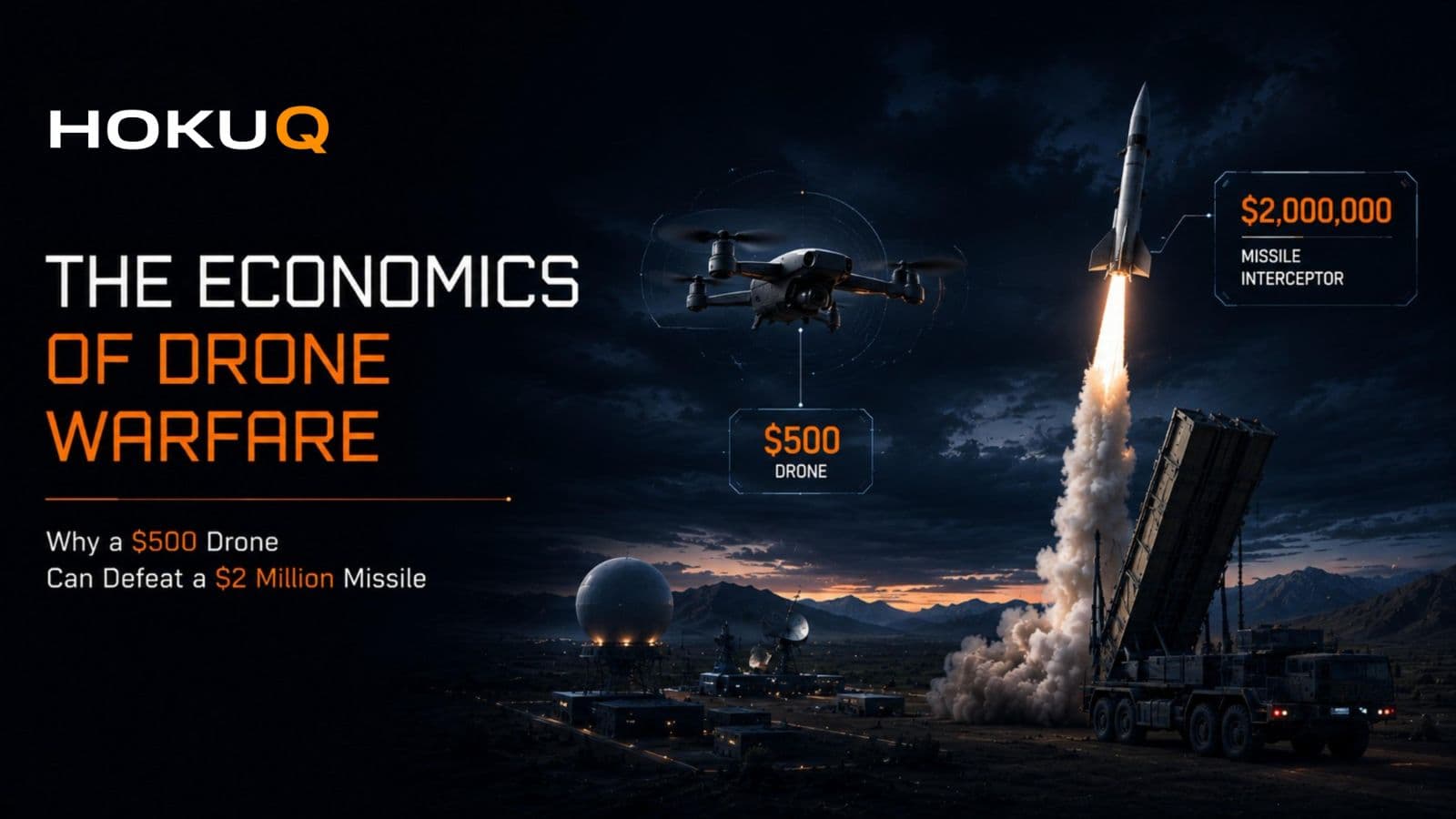
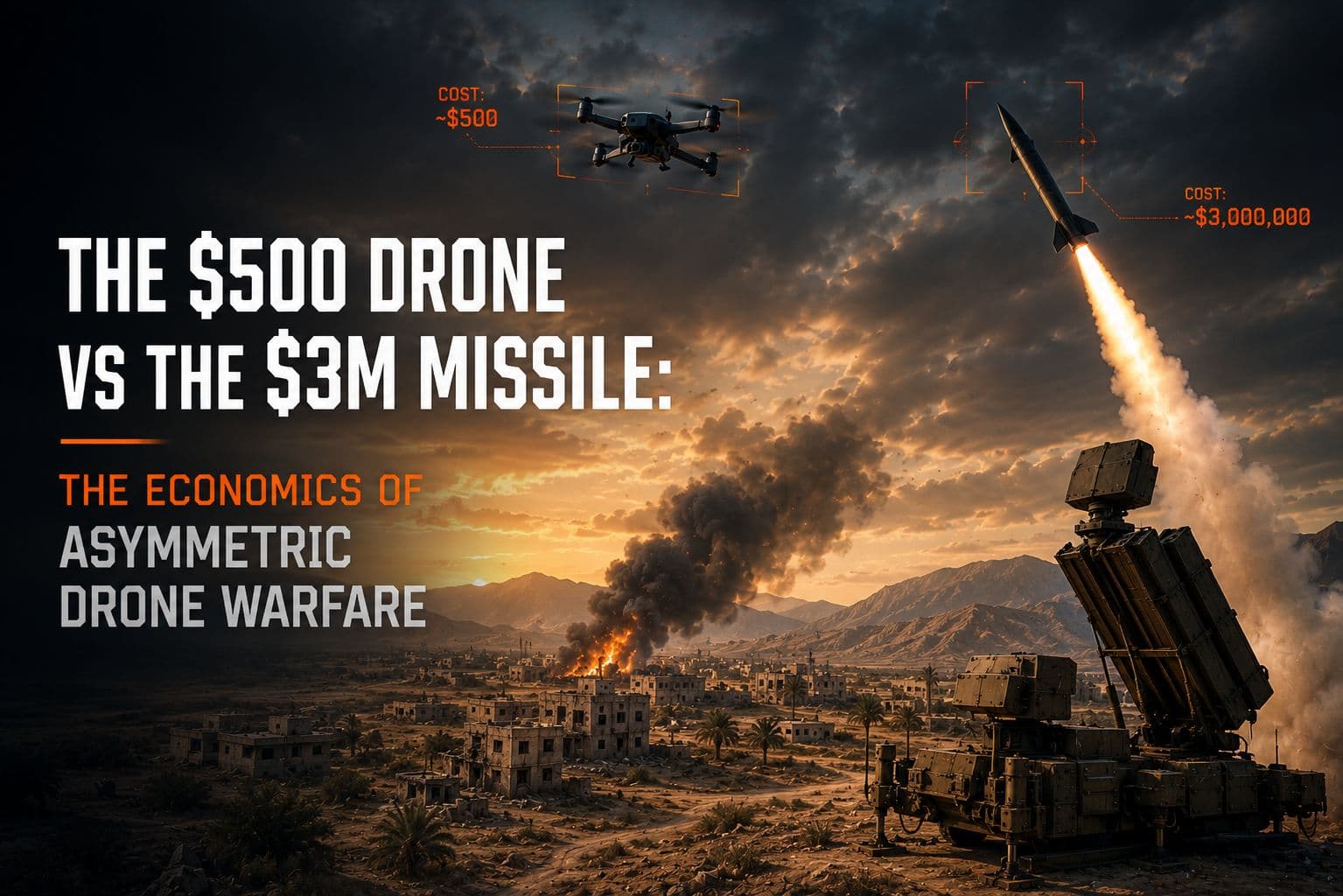
Strip away the technology and the drone-swarm threat is, fundamentally, an economic one. The strategic genius of mass autonomous drones is not any single capability; it is the cost asymmetry. A drone that costs a few hundred to a few tens of thousands of dollars can force a defender to expend interceptors costing millions. Multiply that across a swarm and the math becomes ruinous.
This is the equation that defines asymmetric drone warfare, and it is the equation most defense modernisation fails to address. Understanding it is the key to understanding why the answer cannot be more expensive interceptors, and why it must be a different layer of defense entirely.
The Core Asymmetry
Asymmetric drone warfare is an economic attack: forcing a defender to spend far more to stop a drone than the attacker spent to send it.
The attacker's advantage is cost. Inexpensive drones, produced at scale, can be sent in numbers that compel the defender to respond with far costlier systems. Every exchange drains the defender's resources faster than the attacker's, regardless of who wins the individual engagement.
This is warfare designed to bankrupt rather than merely to destroy. The objective is to make defense economically unsustainable, and against conventional approaches it succeeds.
Why Conventional Defense Loses the Math
Meeting cheap drones with expensive interceptors loses the economic war even when every engagement is won.
A defense that answers each drone with a multi-million-dollar interceptor can shoot down everything and still lose, because the cost of defending exceeds the cost of attacking by orders of magnitude. An adversary that can produce drones faster and cheaper than you can produce defenses will simply send more.
This is the trap of airframe-by-airframe defense. It is tactically effective and strategically self-defeating, and it is the position much of the current counter-UAS market quietly occupies.
Why More Interceptors Is Not the Answer
You cannot out-produce a swarm with interceptors, the economics are structured so that scaling defense the conventional way accelerates the loss.
The instinct to buy more interceptors makes the problem worse, not better. Every additional expensive effector deepens the cost asymmetry the attacker is exploiting. Scaling the conventional approach scales the disadvantage.
Breaking the equation requires changing what a single defensive action accomplishes, defeating many drones at once rather than one at a time. That is impossible at the airframe layer and achievable at the coordination layer.
Defeating the Economics at the Coordination Layer
Disrupting the coordination layer inverts the asymmetry: one action defeats the swarm, not one drone, putting the economics back on the defender's side.
When defense engages the AI coordination stack that drives the swarm, a single disruption can neutralise the swarm as a system rather than a single airframe. This is the only way the cost-exchange equation flips in the defender's favour, because it decouples the cost of defense from the number of drones.
HokuQ is built on this economic logic as much as the technical one: defeat what controls the drones, and you defeat the swarm without matching it dollar for dollar. The asymmetry that makes drone warfare so dangerous is also where it can be broken, at the layer of logic, not the layer of airframes.
Break the economics of the swarm at the coordination layer. Request a HokuQ strategic briefing.