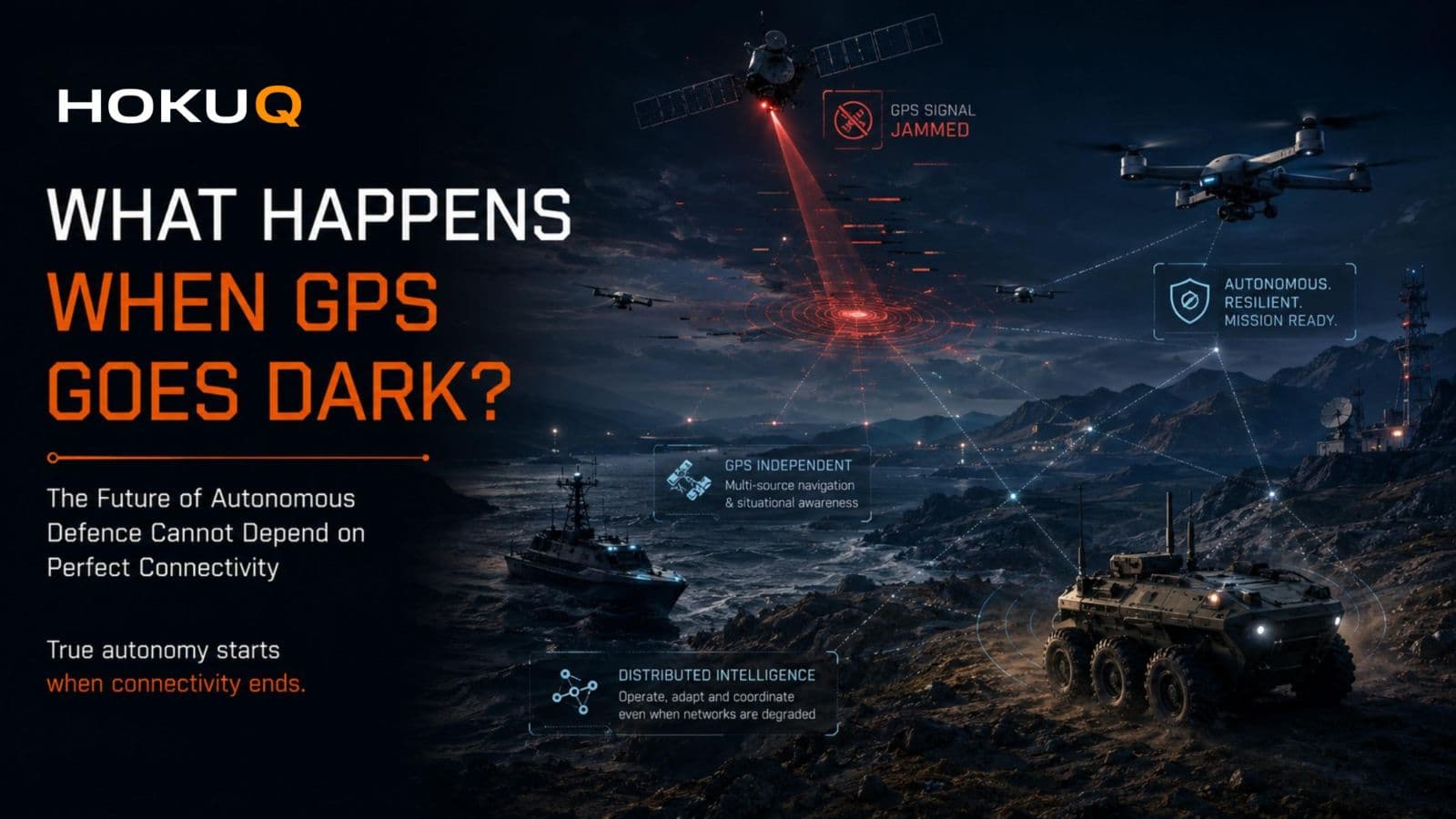
The Future of Autonomous Defence Cannot Depend on Perfect Connectivity
Modern autonomous systems are becoming faster, smarter and increasingly capable.
But many still depend on something that cannot be guaranteed in a contested environment:
A reliable signal.
GPS has become deeply embedded in modern navigation, logistics, communications and autonomous operations. It provides extraordinary capability when available.
But what happens when it is not?
What happens when GPS is jammed?
Spoofed?
Degraded?
Or deliberately denied?
For the next generation of autonomous defence systems, losing GPS cannot mean losing the mission.
That is quickly becoming one of the defining challenges of modern autonomy.
GPS Is an Advantage. Dependence Is a Vulnerability.
GPS was never designed to be the only source of truth for autonomous systems operating in hostile environments.
Yet increasing levels of automation have created growing dependence on satellite based positioning.
That creates an obvious target.
Electronic warfare can attempt to interfere with navigation signals. Spoofing can potentially provide systems with false positioning information. Communications infrastructure can be disrupted or unavailable altogether.
The problem becomes even greater when multiple autonomous systems need to coordinate simultaneously.
If every platform depends on continuous external connectivity to understand where it is, where other systems are and what it should do next, disruption can affect the entire network.
Future autonomous systems therefore need to be designed around a fundamentally different assumption:
Connectivity may disappear.
Autonomy Must Mean More Than Flying Without a Pilot
Removing a pilot from an aircraft does not necessarily make that aircraft truly autonomous.
True autonomy requires a system to continue understanding its environment and making appropriate decisions when the information it normally depends upon becomes incomplete.
That means autonomous systems need multiple ways of understanding where they are, what is around them and how they should continue operating.
Rather than relying on a single source of navigation or intelligence, resilient autonomous architectures can combine multiple sources of information and continuously determine which information should be trusted.
The objective is not simply autonomous movement.
It is autonomous resilience.
From Connected Autonomy to Resilient Autonomy
There is an important difference between a system that operates autonomously while everything is working and one designed to operate when things stop working.
That distinction becomes critical in defence.
A resilient autonomous system should be designed to function through uncertainty.
Navigation signals may disappear.
Communications may become intermittent.
Individual systems may become unavailable.
Information may become unreliable.
Environmental conditions may change rapidly.
The architecture must anticipate disruption rather than treat disruption as an exception.
The system should expect the environment to fight back.
A Swarm Cannot Depend on One Brain
The challenge becomes even more significant with autonomous swarms.
A group of autonomous systems operating together can potentially create capabilities far greater than those of an individual platform.
But only if the intelligence behind that network is resilient.
If every autonomous system depends entirely on one centralized command point, one communications link or one source of positioning data, the network can inherit a significant vulnerability.
Distributed intelligence changes that architecture.
Individual systems can contribute information to the broader network while maintaining the ability to make decisions locally within established mission parameters.
The swarm becomes more than a collection of connected machines.
It becomes a distributed autonomous network.
That creates the potential for systems to continue coordinating even when parts of the network are degraded.
Intelligence at the Edge
The future of autonomous defence will increasingly require intelligence to exist where decisions are actually being made.
At the edge.
On the platform.
Across the network.
Within the swarm.
Sending every piece of information back to a centralized system for processing may not always be practical when communications are contested or unavailable.
Edge intelligence allows autonomous systems to process information locally and respond without requiring continuous external connectivity.
This can reduce latency while increasing resilience.
It also changes the role of communications.
Connectivity becomes an advantage rather than an absolute requirement.
Human Command. Machine Resilience.
Greater autonomy does not have to mean removing human authority.
The objective should be to give human operators the ability to establish mission objectives, permissions and operational boundaries while enabling autonomous systems to function within those parameters.
Humans define the mission.
Machines provide speed, coordination and resilience.
This distinction becomes increasingly important as autonomous systems begin operating in environments where communications may not always be available.
A system should not require a human operator to manually control every movement.
But autonomy must operate within clearly established controls.
The challenge is not simply creating systems capable of operating independently.
It is creating systems capable of operating independently and responsibly.
The Next Battlefield Will Contest Connectivity
The autonomous systems of tomorrow will operate in environments where information itself is contested.
Navigation may be attacked.
Communications may be disrupted.
Sensors may encounter conflicting information.
Networks may become fragmented.
Autonomous systems will therefore need to do more than operate when conditions are ideal.
They will need to adapt when conditions are not.
This represents an important evolution in autonomous defence.
From remotely controlled systems.
To connected autonomous systems.
To resilient autonomous networks.
The HokuQ Vision
At HokuQ, we believe the future of autonomous defence will be defined by intelligence, coordination, resilience and trust.
The physical platform is only one part of that equation.
The greater opportunity lies in the intelligence connecting autonomous systems and enabling them to operate collectively in increasingly complex environments.
Systems that can sense.
Systems that can communicate.
Systems that can coordinate.
Systems that can adapt.
And systems designed to continue operating when traditional infrastructure becomes unreliable.
Because the true test of autonomy is not what happens when everything works.
It is what happens when it does not.
WHAT HAPPENS WHEN GPS GOES DARK?
The mission cannot simply go dark with it.
True autonomy starts when connectivity ends.